Blog

Articles en anglais, Pilates

Who is this Helping?

Negativity, Toxicity and the Weaponization of Social Media in the Pilates Community

Remember when social media used to be ….fun? Seems like eons ago, right? I’ve been on social media probably  11 years. At first, it was fabulous, reigniting old friendships, forging new ones. I was particularly chuffed to connect with fellow Pilates teachers from around the globe.  Pre-Facebook, I had participated in the now defunct Pilates Connections forum online, but the Pilates Facebook community numbered in the hundreds, then thousands. It was exciting to discuss Pilates 24/7.  I even co-founded my own forum with some friends,  the Pilates Book Review and Discussion Club.  Of course, there were arguments, but the positive largely outweighed the negative.  And disagreements are natural and even healthy.  Listening to and considering viewpoints that differ from our own help us grow as individuals and become more open-minded  and tolerant.  The forums abounded with lively and sometimes hilarious discussions about whether to wear shoes while teaching, best cues for the pelvic floor (“winking the anus”).  We started having Friday questions, a great and fun way to interact with other Pilates  geeks, learn more about the history of Pilates and early forms of physical culture.    There were also technical  and business questions.   The forums were informative and amusing.

The honeymoon phase was unfortunately short-lived.   Lively discussions turned heated, and then venomous.   I learned that there was a classical and contemporary Pilates divide.  People were kicked off of some forums or left of their own volition to create new ones. In this new social media world existed  forums for classical Pilates teachers,  forums for contemporary  teachers, forums for contemporary teachers who wanted to become classical,  forums for people with no particular affiliation.  I realized that each “camp” felt bullied and derided by the others, and that many believed and loudly trumpeted their belief in the superiority of their training. I participated in all of the forums,  choosing to interact with a variety of people instead of isolating myself among teachers who had the same training that I had. Some of the discussions in which I did get involved in were animated, and at times, tense;  but overall, I mostly managed to avoid being sucked into conflict.  I was fairly successful at maintaining friendships with diverse people, although some of them actively disliked each other.  The key was not taking “sides” and recognizing that there were many viewpoints.

During the last few years,  navigating the tricky Pilates waters became increasingly challenging. Facebook had already become  rife with bitter disputes about politics and,  more recently,  subjects relating to the pandemic- masks, vaccination….  Although I used to enjoy the occasional debate (I used to be in the debate and Model UN teams in high school, and am an ex-lawyer),  these arguments were neither productive nor constructive.  I made a personal decision to avoid hot topics on social media and firmly resolved to distance myself from any Pilates disputes. My activity became limited to liking pictures of babies and pets, although I did and still do run a Pilates forum in France where most people tend to get along.  Meanwhile, the  old debates among the Pilates community about what was better, classical or contemporary, raged on and also gave way to new debates along similar lines, but now with “factions”.  Additionally, newer teachers criticized older ones as being out of touch with science, and older teachers derided newer ones as being too far from the source to have anything important to share.  Participants began to weaponize social media not only on Facebook but also on Instagram which initially was a safe haven where people just shared pretty pictures. Now began a new era of name calling and finger pointing and passive-aggressive (and sometimes simply aggressive) Instagram stories.   Social media was officially no longer fun.  The negativity and toxicity within these forums was magnified compared to the “real world “, as hiding behind a screen and trading barbs online is easier than having a meaningful conversation.  This  made the forums a stressful rather than safe and funspace to share. Even a seemingly benign act like « liking » or sharing a post became interpreted as choosing  “sides”. Friendships became alliances.  Dislikes became enemies.  The result was inevitably an acute decline in social media activity.

The decline in social media activity is obviously a result of  multiple factors. Pilates teachers are more worried about staying healthy and keeping their families and  businesses alive during COVID  than participating in petty disputes on social media. But in addition to having less time for digital interaction, there is unquestionably a social media burnout.  It is a shame because we need each other more than ever.   As we are reopening our businesses and trying to recover from a very difficult couple of years and also to integrate online classes into our business models,  it  is increasingly important that members of the Pilates community remain united. Most of us did not get into this business to make a fortune, but rather to help others move and feel better in their bodies. We don’t have time to reopen old wounds or inflict new ones.  It is unhealthy and we should be using our energy and resources to help each other rebuild. 

We need to get back to doing to using our tools and skills to be productive and helpful to our families, our friend, colleagues and students.  You may be asking yourself, “who is this Rebekah person and why is she so self righteous ?” The answer is that I am no one and yet I am  everyone.  I’m not famous nor do I aspire to be famous. I’m just a mother of four kids (and a dog).   I also am a Pilates teacher. My goals are to become the best version of myself as a teacher and a person, to help my students and my fellow teachers if and when I can. Probably your goals are pretty similar. So the next time you find yourself on social media ready to make a great clap-back  or even  encourage or “like” a negative or divisive post,  ask yourself the important questions:  

Who is this helping? 

Is it really  worth it?  

I think you may realize the value in stepping back.  And moving on.  If you think I’m  sticking my head in the sand,   I’m okay with that.  I have plenty of toys in my Pilates sandbox with which to play and hopefully, plenty of pals who want to do the same.  Let’s remember why we became teachers.

Life is short.

Just keep calm and do Pilates.

About the Author

Rebekah is a supremely talented and accomplished human being. In fact, she is so accomplished that to list her myriad accomplishments would take too much time. Suffice it to say that she was voted best all-around in preschool and has saved a ladybug on more than one occasion. She is so nice to animals that she does not even have to be nice to other people. She does not post many pictures on facebook because she does not want others to feel bad about themselves. The word that people use most frequently to describe her is enchanting, although delightful is a close second. She teaches Pilates in her home studio in France (over 200 hours a week), where she is not above making her students do extra teasers if they question her authority or mock her accent. Yes, rumor has it that a few people have apparently dared mock her, but when we went to question them, we couldn’t find them anymore. *note- for those of you who don’t know me, this bio is meant to be humorous and there is no intention to offend animals, ladybugs or humans.

Pilates

Is it time to drop the C Words from our Pilates Vocabulary?

Mea culpa – yesterday, I used (one of) the C words.  Twice.  No, I lied – three times!  What, you gasp, nooooo!?!  YES and…, I’ll do it again.  Classical.  Classical.  Classical.  For those who didn’t hear it the first three times.  Classical.  Really, Rebekah, you’re starting to sound like “one of them”. Um, one of whom?  One of them, an elitist.  Because I describe my teaching as classical?  Exactly.  The terms classical and contemporary Pilates lead to arguments,  fighting and probably, the Apocalypse.  Whoa, slow down there.  How does using the term classical lead to the Apocalypse?  Because when you describe yourself as a classical teacher, you imply that classical is superior to contemporary.  That is wrong and in fact exemplifies all that is wrong in the universe.  Away with these distinctions.  Really? But how will people know what I am teaching? They don’t need to know.  Just say you teach Pilates.  So is all Pilates the same, and is everything Pilates just because someone says it is?  Uhhhhh.  Yes.. I don’t know.  Maybe?

Sound silly?  I am obviously exaggerating, but only slightly.  Some members of the Pilates community recently opined that we should no longer use the terms classical and contemporary.  And the editor of Pilates Style Magazine announced that the magazine would not use them because they fostered negativity, an “‘us v. them’ mentality”, and that eliminating them would make “our Pilates world a better place.”  I disagree.  This is not a revival of the tired classical v. contemporary debate.  It is not “us versus them.”  But all Pilates is not the same and pretending otherwise won’t make it so.   As my friend Maria stated when this subject was discussed on social media, “ everyone uses the term classical music or contemporary music .  There are the classical philosophers and the contemporary ones.  Can we just wake up one day and say music is music and philosophy is philosophy….”  There is not A Pilates style; there are styles, plural.  Classical and contemporary are the two primary styles.

Those who seek to abolish the terms classical and contemporary Pilates claim that the Pilates world will be a better place if we do so.  Is this argument an attempt to couch what is in reality a business decision (sell more magazines, attract more students..)?  Or is it misguided political correctness?  Probably a bit of both, but mainly the latter.  Much as the trend toward excessive political correctness in recent years has taken a nosedive into the realm of the ridiculous, the same phenomena is starting to take root in the Pilates world.  We cannot describe our style or lineage without offending those who do not conform to the definitions we use.  Shall we no longer use any descriptions that others might find exclusive?  In that case, should we even use the term Pilates teacher? Why not movement professional?  Or simply professional so that we don’t offend non-movement professionals.

Another argument espoused by those who want blur the lines is that the term classical Pilates is not universally agreed upon even within the classical Pilates community.  (I do not know if this disagreement exists with the contemporary Pilates world).  This is not false.  There is indeed disagreement as to what is considered classical, particularly as there has been a recent shift toward classical and more teachers are beginning to explore the original work. Some believe that classical Pilates refers exclusively to the Romana lineage; others consider it to include the work of the other elders.  But since when do let the failure to achieve a consensus on a definition lead us to just wipe out the word from our vocabulary? That is intellectual laziness.  Again, drawing a parallel to the word Pilates itself – it appears improbable that the Pilates community will ever agree upon a universal definition of the term Pilates.  That ship arguably sailed in the year 2000*.  Does that mean that we should no longer use the term Pilates?

Will blurring the classical/contemporary lines result in a kinder, gentler Pilates world? I defy someone to produce a shred of evidence that substantiates that theory.  Were we to drop the terms men and women, would gender equality ensue, would the pay gap disappear and would sexual discrimination, harassment and violence cease?  If we no longer used the terms Democrat, Republican, liberal or conservative, would everyone hold hands and sing Kumbayah?  Sure, and unicorns and leprechauns exist too.  That people have different opinions on pretty much everything  is reality, and a healthy one.  Negativity ensues when people are incapable of reasonable discussions to voice their opinions.  The use of the terms classical and contemporary Pilates is not the source of the negativity pervading the Pilates community.  The two styles are different.  It is  futile to pretend that they are not,  or to close our eyes and hope the differences go away or go unnoticed.  Expressing a preference for one or the other is in no way equivalent to belittling those who teach differently.  Admittedly, this behavior (belittling) has unfortunately occurred within both the classical and contemporary communities.  However, and  again I cite my friend Maria who astutely stated, “our Pilates world becoming a better place has nothing to do with classical or contemporary.  It will become a better place when people become better people.”  Let’s direct our energy toward becoming better people and teachers .  (Apologies to all non-teachers and non-people I may offend with these terms).

Finally, I would argue that, in our post-lawsuit era*, when anyone can say they teach Pilates, we need these distinctions more than ever.  This sentiment has been echoed by both classical and contemporary teachers.  As my friend Cathy commented, “this is a slippery slope to dumbing down both/all styles of Pilates.  There needs to be a distinction made for purposes of training, for clients who walk into a studio to know what they are paying for, and to continue to honor the work that was developed by Joseph Pilates and by the First Generation teachers, and by modern  teachers who create exercises based on his work.”  It is both possible and rewarding to be part of a greater Pilates community, while maintaining our classical or contemporary identities and also our unique personal identities. Instead of worrying that we weren’t invited to the cool kids party down the block, let’s make our own party.  Ultimately, it boils down to a choice –   celebrate our shared heritage AND our differences?   Or take offense where there is none meant?  Take pride in our own teaching or censor those who choose to underscore their differences? My choice is made.  I plan to keep using the C words.  What about you?

*October 2000 – the term Pilates was deemed a generic term that could not be trademarked.

About the Author

laracroftRebekah is a supremely talented and accomplished human being. In fact, she is so accomplished that to list her myriad accomplishments would take too much time. Suffice it to say that she was voted best all-around in preschool and has saved a ladybug on more than one occasion. She is so nice to animals that she does not even have to be nice to other people. She does not post many pictures on facebook because she does not want others to feel bad about themselves. The word that people use most frequently to describe her is enchanting, although delightful is a close second. She teaches Pilates in her home studio in France (over 200 hours a week), where she is not above making her students do extra teasers if they question her authority or mock her accent. Yes, rumor has it that a few people have apparently dared mock her, but when we went to question them, we couldn’t find them anymore. *note- for those of you who don’t know me, this bio is meant to be humorous and there is no intention to offend animals, ladybugs or humans.


Pilates

When is it No Longer Pilates?

Something caught my eye at the store recently– an aisle with exercise equipment – weights, a Pilates ball (which looks disarmingly like a Swiss ball), and a Pilates Circle.  In France, where exercise is still exotic, this is new and exciting.  Suddenly, Pilates is everywhere.  Skimming through a fitness equipment catalog, I find a Pilates foam roller (which, strangely, looks just like a normal foam roller).   The sporting goods store devotes an entire aisle to “Pilates clothes” (apparently the powers-that-be don’t think people sweat during Pilates because none of it looks sweat-proof).  At the bookstore, I count at least a dozen Pilates books.  On the Internet, I learn of Pop Pilates, Aerolates,  Piloxing,  Piyoga, Yogilates,  Zumbalates, Poolates (my guess is that this has something to do with water and not excrement) and Hot Pilates.  There is a site called pornolates.com and a trademark for sexilates (which lapsed, so it is up for grabs if you are interested).    All the local gyms, vacation resorts, physiotherapists and mid-wives also teach Pilates classes.  It’s raining Pilates!!  But is it really Pilates?  When is it not Pilates?  Enquiring minds want to know.  I want to know.

I don my Jimmy Olsen cap to investigate.  First, what is naked Pilates?  There are a surprising number of videos on the Net.  Please, you are totally going to check it out too.  I find a video with two women who appear to have some Pilates education.   One begins to speak authoritatively about the powerhouse, but then proceeds to say that the pelvic floor, (consisting of the sacrum and the tailbone) must touch the mat.  Um, what?!?  I think that would be cause for alarm as in – Houston, we have a problem!  My pelvic floor is on my Pilates mat, please call an ambulance!  I stopped watching when it became sadly evident that Harrison Ford was not going to make an appearance.  Also, my kids were becoming curious about what I was watching and I doubt they would be convinced that I was doing “research”.  Ten hours later (joke) I am no closer to knowing what is not Pilates and I also don’t know why one would need a knit cap for naked Pilates.  Conclusion – naked Pilates probably isn’t Pilates, but viewers are likely looking for a different sort of “Teaser”.   And “in and up” – well I won’t go there.

Perhaps it is easier to start with the question – what is Pilates?  As a friend put it – is it Pilates just because we say it is or because we want it to be?  Does anything go as it long as it respects the oft-cited “Pilates principles” – centering, control, concentration, breathing, precision and fluidity?  These principles were not defined by Joseph Pilates himself, but by the 1980 Friedman/Eisen book on Pilates and have since been widely adopted. Frequently teachers insist that Joe would be delighted by the changes to his method and would have encouraged teachers to give free rein to their creativity.  Easy to say, but problematic to prove since Joseph is deceased and there is no “Return to Life” after death, as far as we know.

Do teachers really believe that anything goes – “fusion” classes, gym classes, large group reformer classes?  What if the instructor doesn’t know the difference between Joseph Pilates and Joseph Smith, founder of Mormonism (as one teacher recounted)? What if the teacher just barks instructions and provides no corrections? What if few or no exercises resemble those in Return to Life, if props like the Bosu, swiss ball or foam roller, which have origins in other methods, are used?  We all laugh when Pilatesology airs parodies with the baby chair on the reformer and the ladder barrel upside down, but that is not that farfetched given what we see on Instagram.  Blaring music?  Concentrating on Sir Mixalot’s fondness for big butts will take our attention away from our own derrière.

Social media is alive with Pilates images, many of them recognizably Pilates, others less so.  Some look useful, others, well…. less useful.  I find myself scratching my head (no, not lice) … is this still Pilates?  At times, the answer is a no-brainer.  Dangerous exercises are clearly not Pilates.  Ever.  End of story.  More often the answer is murky.  And there is a backlash against the so-called Pilates police – any comment that could be perceived as mildly critical is found offensive and its author all but tarred and feathered.  Perhaps we are taking an admirable idea – inclusiveness – too far.  We have no legal standards defining Pilates -should we have no standards at all?

I took the question to a non-classical facebook forum and was surprised to be met with strong opinions on the subject and a clear rejection of the “anything goes”assertion.  Many decried the proliferation of “crapilates”.  But the line between Pilates and Pile-of-shit-ates was unclear.  What makes something Pilates and something else, Poo-lates?  Is it only a question of being safe and functional and following the “principles”?  A good vinyasa or Iyengar yoga class could follow the “principles”.  Can yoga be Pilates?  It does sound silly, but if you consider that any safe movement class that follows the “Pilates principles” is Pilates, then yoga could be Pilates, and even cooking could be Pilates.  A friend of mine suggested that a Pilates class should have a significant number of original Joe exercises.  What is significant?  Ninety?  Fifty?  Twenty?

Many teachers assured me that they harbor the same concerns.  Yet each had a different view of what Pilates isn’t.  Classes that were too slow were not Pilates.  Classes that were too fast were not Pilates.  Adding props like Swiss balls, flexbands or Bosu were not Pilates.  Fusion classes – no.   Too much breath, not enough movement; too much movement, not enough breath.   Too much sweat, not enough correction; too much correction, not enough sweat.  Like Monica on Friends trying to duplicate the chocolate chip cookie recipe, no one could quite pin down the special ingredient that makes Pilates what it is.  Not just the exercises themselves because, as one person noted, a bicep curl could be a simple curl or it could be done in a way that would make it Pilates.  The intention behind the movement is equally important as the movement itself.  Not just the “principles” because other movement methods that are not Pilates may also respect the “principles”.  Not just the equipment because swinging like Tarzan from the trapeze bar does not a Pilates practitioner make.  Not the lack of equipment because Pilates can be done with only a mat.  Some asserted that a Pilates class needs to reference RTL in some way, that the exercises should be traceable back to the originals, that the teacher should, at the very least know who Joseph Pilates was.  Most agreed that a true Pilates teacher needed to undergo a comprehensive and not a weekend program.  And everyone concurred that teachers must respect the integrity of the method, and not merely exploit the name for marketing purposes. One person wrote, “I suspect that what is not Pilates is like porn.  I know it when I see it.”

Social media, however, reminds us daily that many believe that we should be creative with the method.  One teacher wrote that when an experienced teacher truly understands the method, he should feel free to create new exercises.  After all, Joseph both invented and borrowed from others.  True, but he made the method his own and gave it its own name and now it bears his name.  At what point does the creation deviate enough from the original that it should be its own creation?  When grandma no longer recognizes her chocolate cake recipe, it really isn’t still grandma’s chocolate cake.  And she wouldn’t want you to call it that, delectable though it may be.  If it really doesn’t look or act like a duck, maybe it just isn’t a damn duck.  And that’s fine.  It doesn’t need to be a duck.  When a teacher injects enough of his own inventions into the work so that Joe would no longer recognize it, or criticizes Joe’s work as unsafe or primitive, why even bother calling it Pilates? It isn’t Pilates anymore. It is something else.

Some people have argued that no one cares.  That assertion is patently untrue.  SOME people are simply looking for a safe, fun workout and don’t care what it is called.  But many do care and consider it important that the public learn what Pilates is.  They are concerned that non-Pilates classes using the Pilates name either give Pilates a bad reputation because they are, excuse my French, crap, unsafe or misleading.  Contrary to what many say, there is no Pilates police.  I am a not nor do I want to be, a Pilates policeman –this isn’t about me.  But it does matter what the Pilates teaching community promotes as Pilates because that is ultimately what the public will believe.  It is a fact that there is no Pilates trademark – anyway can say that they teach Pilates.  Anyone can also call yoga Pilates.  Legally.  But ethically?

This is a call for reflection –upon our responsibility as teachers to acknowledge and honor the work that went into creating the method, to uphold its integrity, and that of its creator.    Pilates should not be about egos or Instagram likes.  Would Joe have been delighted about the myriad changes to his method that bears his name ?  I am skeptical. Naked Pilates?  Although he DID suggest that one should wear as little as possible to work out, I doubt that he foresaw that naked Pilates would be a thing.

Do not go around policing others or trolling the Internet, but be your own police. Joseph entrusted his method to his teachers, who in turn gifted us with it.  With this gift comes responsibility.  Let us be responsible.  Let us be vigilant against denaturing the method into something that Joe would not recognize.

*special thanks to Patty Turner Mehl for the « porn quote » and the Joseph Smith anecdote.😂😂.

About the Author

laracroftRebekah is a supremely talented and accomplished human being.  In fact, she is so accomplished that to list her myriad accomplishments would take too much time.  Suffice it to say that she was voted best all-around in preschool and has saved a ladybug on more than one occasion. She is so nice to animals that she does not even have to be nice to other people.  She does not post many pictures on facebook because she does not want others to feel bad about themselves.  The word that people use most frequently to describe her is enchanting, although delightful is a close second.   She teaches Pilates in her home studio in France (over 200 hours a week), where she is not above making her students do extra teasers if they question her authority or mock her accent.  Yes, rumor has it that a few people have apparently dared mock her, but when we went to question them, we couldn’t find them anymore.

Articles en anglais, Pilates

Discover Pilates: a complete method for body and mind


Pilates is above all a global, coherent, and deeply thought-out system, designed by Joseph Pilates as a method to strengthen the body, improve posture, mobility, and overall health. Each exercise, each detail of alignment or breathing, is an opportunity to refine body awareness. The work often begins with forgotten areas, such as the toes or ankles, and then expands to the overall alignment of the body, the activation of the “powerhouse” and spinal mobility. This progressive and precise approach allows everyone, regardless of level, to embrace the fundamental principles of Pilates: centering, control, concentration, precision, flow, and breathing.

Joseph Pilates did not only create exercises on the mat, but also developed a series of specific apparatuses—such as the Reformer, Cadillac, Wunda Chair, Barrels, and the Guillotine—each playing a precise role in the evolution of the practice.

Matwork vs. Apparatus: two complementary approaches

Matwork exercises (on the floor with a mat) develop core strength, motor control, and endurance using body weight. In contrast, spring-based apparatus such as the Reformer or Cadillac add adjustable resistance or support depending on the practitioner’s level, allowing exploration of movement with greater range, precision, or load.

Both approaches complement one another: Matwork refines stability and body awareness, while the apparatus provides postural guidance, either facilitating or challenging movement as needed. Together, they embody the progressive and structured logic of the Pilates system, as its founder envisioned.

Until recently, Pilates apparatus were less known to the general public than matwork, as they were used mainly in private or duet sessions. Most people associated the word Pilates with matwork exercises, often practiced in group classes.  But in recent years, apparatus work has gained recognition, and very recently Reformer group classes have multiplied throughout the world.

The Reformer: an iconic apparatus

The Reformer is one of the most emblematic pieces of the method. With its moving carriage, adjustable springs, and straps, it allows deep muscular work while improving posture, flexibility, and balance. It encourages fluid, controlled movements with tailored resistance, strengthening muscles without harmful impact on the joints.

Other apparatus: depth and precision of practice

The Cadillac (and Wall Units)

The Cadillac is a central apparatus in the classical method, designed to guide, correct, and strengthen through a system of suspended springs. In smaller studios, it is often replaced by a wall-mounted version, the Wall Unit, which allows much of the same work while saving space. Both provide support and resistance, improve postural alignment, stability, and flexibility, and strongly engage the powerhouse.  Some Cadillac exercises cannot be performed on the wall unit; however many studios offer group classes using the wall unit and combining matwork with exercises traditionally performed on the Cadillac.


The Chairs

  • Wunda Chair

The Wunda Chair is both compact and extremely demanding. It allows work in seated, standing, or lying positions, intensely engaging the core while strengthening the arms, legs, and postural muscles. It is ideal for developing functional strength, balance, and coordination in a minimalist format.

  • Baby Chair

The Baby Chair (or Arm Chair) is less known than the Wunda or High Chair. It mainly targets the upper body, promotes chest opening, and strengthens the arms, shoulders, and postural muscles. Its work is subtle, precise, and often overlooked, yet highly effective, particularly for correcting slumped postures or relieving neck tension.

  • High Chair

The High Chair, also called the Electric Chair, is a powerful apparatus combining resistance and support. With its backrest, pedal, and springs, it provides a stable framework for strengthening postural alignment and developing functional strength, especially in the legs, trunk, and shoulder girdle. It allows both standing and seated exercises, making it particularly useful for improving balance and proprioception.


The Barrels: mobilizing the spine and opening the upper body and hips

  • Ladder Barrel

The Ladder Barrel combines a vertical ladder with a rounded barrel, forming an ideal tool to stretch and strengthen the back, hips, legs, and shoulders. It promotes spinal lengthening while emphasizing fluidity and control of movement. Exercises on the Ladder Barrel enhance body awareness and help restore a natural, balanced posture.

  • Spine Corrector

The Spine Corrector was designed to improve spinal mobility, open the chest and hips, and strengthen the deep core muscles. Its curved shape allows gentle exploration of back and hip extensions. It also helps work on breathing, pelvic stability, and movement fluidity, while respecting the spine’s natural curves and correcting postural imbalances.

  • Small Barrels

Small Barrels are small arcs designed to support the natural curves of the spine. They allow extension and side-bending exercises while respecting spinal alignment. They are particularly effective for loosening the back, opening the chest and hips, releasing tension, and deepening body awareness.

A method to be rediscovered as a whole

To truly understand and integrate the benefits of Pilates, it is essential to approach it as a complete system, just as Joseph Pilates envisioned it. Matwork, apparatus, breathing, movement control, and body awareness form an inseparable whole. By combining the different formats and tools, one discovers the full richness, logic, and depth of this timeless method.

Reformer Pilates: between method and fitness

Today, many studios and gyms offer what they call “Reformer Pilates,” often a very dynamic practice focused on quick toning and physical intensity. While these classes can be effective for muscular conditioning, they sometimes stray from the essence of the method: conscious work centered on precision, breathing, control, and the mind-body connection.

Joseph Pilates never designed his method as a simple series of exercises, but as a complete system of health and well-being, with logical progression, fine attention to alignment, and impeccable movement quality. Practicing only on the Reformer, in a fitness-oriented way, without knowledge of the other apparatus or Matwork, means discovering only a superficial part of the richness of classical Pilates.

Number of participants on Reformers: safety and quality

It is essential not to overcrowd Reformer classes, particularly for safety reasons. While highly effective, this apparatus requires attentive supervision, especially for less experienced practitioners. Too many participants limit the teacher’s ability to observe, correct, and adjust individually, increasing the risk of poorly executed movements or even injuries.

Beyond safety, overly large groups also make it harder to give clear instructions and personalized corrections. This can affect the quality of instruction and slow progress. In contrast, smaller groups allow more precise teaching, individualized attention, and a safer, more effective practice.

Private or semi-private lessons: which approach to choose?

In private or duet/trio lessons, the work is entirely personalized. The teacher adapts exercises according to specific needs, conditions, and goals, using the full range of apparatus and ensuring precise, safe guidance.

In small group classes (often 6 to 8 people), you benefit from individualized supervision while enjoying the group’s energy. The small numbers allow the teacher to give tailored guidance. However, the work is generally limited to Matwork (and more recently Reformer exercises in some studios) with small props, without access to the full range of apparatus.

How to choose?

  • Private sessions are ideal if you have specific goals (rehabilitation, performance, posture, targeted physical preparation). The teacher adapts every exercise to your body and needs. This option is also best if you have physical limitations or conditions. It is the most expensive, but offers tailored guidance, highly effective for quick progress or correcting deep imbalances.
  • Small group are perfectly suited for regular, motivating, and structured practice, with personalized support within a small group. This option is possible even with certain physical limitations, as long as they are minor or well understood, and the teacher is informed beforehand. More affordable, small group sessions still allow for good individualized attention while sharing the cost.  Often studios offer duets and trios on the apparatus.

Whether you choose group, private sessions or duets/trios, it is essential to keep in mind that quality of movement matters more than quantity. By respecting the spirit of the method and exploring its many facets, everyone can gain lasting benefits adapted to their needs, abilities, and pace. Rediscovering the full depth of the Pilates method also honors its creator’s legacy, helping each person find a strong, mobile, aligned, and aware body.


Articles en francais, Pilates

Découvrir le Pilates: une méthode complète pour le corps et l’esprit

Le Pilates : un système complet et intelligent de mouvement

Le Pilates est avant tout un système global, cohérent et profondément réfléchi, conçu par Joseph Pilates comme une méthode de renforcement du corps, d’amélioration de la posture, de la mobilité, et de la santé globale.  Chaque exercice, chaque détail d’alignement ou de respiration, est une opportunité d’affiner la conscience corporelle. Le travail commence souvent par des zones oubliées, comme les orteils ou les chevilles, pour ensuite s’étendre à l’alignement global du corps, l’activation du centre (en anglais on parle du “powerhouse” ou « core ») et la mobilité vertébrale. Cette approche progressive et précise permet à chacun, quel que soit son niveau, de s’approprier les principes fondamentaux du Pilates : centrage, contrôle, concentration, précision, fluidité et respiration.

Joseph Pilates n’a pas seulement imaginé des exercices sur tapis,  mais a aussi créé une série d’appareils spécifiques – tels que le Reformer, le Cadillac, la Wunda Chair, les Barrels ou encore la Guillotine – chacun ayant un rôle précis dans l’évolution de la pratique.

Matwork vs Appareils : deux approches complémentaires

Les exercices au sol sur tapis (Matwork) développent la force de centre, le contrôle moteur et l’endurance à partir du poids du corps. En revanche, les appareils à ressorts, comme le Reformer ou le Cadillac, ajoutent une résistance ou un soutien modulable selon le niveau du pratiquant, permettant d’explorer le mouvement avec plus d’amplitude, de précision ou de charge.

Les deux approches sont complémentaires : le Matwork affine la stabilité et la conscience corporelle, tandis que les appareils permettent de progresser avec une meilleure guidance posturale, facilitant ou challengeant le mouvement selon le besoin. Ensemble, ils incarnent la logique progressive et structurée du système Pilates, tel que l’avait conçu son fondateur.

Les appareils de Pilates étaient toutefois moins connus du public jusqu’à recemment car utilisés principalement en cours particuliers ou à deux.  Le grand public associaient surtout le mot Pilates avec des exercices  sur le tapis (Matwork)  pratiqué souvent en cours collectifs, appelés “mat classes”.  Mais depuis quelques années, le travail sur appareil commence à se faire connaître.  Et très recemment les cours collectifs sur Reformer se multiplient en France..

Le Reformer : un appareil emblématique

Le Reformer est l’un des appareils les plus emblématiques de la méthode. Grâce à son chariot mobile, ses ressorts réglables et ses courroies, il permet un travail musculaire en profondeur, tout en améliorant la posture, la souplesse et l’équilibre. Il favorise des mouvements fluides et contrôlés, avec une résistance adaptée, pour un renforcement musculaire sans impact nocif sur les articulations.

Les autres appareils : richesse et précision du travail

Le Cadillac et les Wall Units

Le Cadillac est un appareil central dans la méthode classique, conçu pour guider, corriger et renforcer à travers un système de ressorts suspendus. Dans les studios plus compacts, il est souvent remplacé par une version murale, le Wall Unit, qui permet de retrouver une grande partie de ce travail tout en gagnant de l’espace. Le Wall Unit comme le Cadillac, apporte un soutien et une résistance, améliore l’alignement postural, la stabilité et la souplesse, et sollicite intensément la sangle abdominale.

Les Chaises :

 La Wunda Chair

La Wunda Chair est un appareil à la fois compact et extrêmement exigeant. Elle permet un travail en position assise, debout ou couchée, engageant intensément le centre du corps tout en renforçant les bras, les jambes et les muscles posturaux. Elle est idéale pour développer la force fonctionnelle, l’équilibre et la coordination dans un format minimaliste.

La Baby Chair

La Baby Chair (ou Arm Chair) est un peu moins connue que la Wunda ou la High Chair.  Elle cible principalement le haut du corps, favorise l’ouverture thoracique, renforce les bras, les épaules et les muscles posturaux. Son travail est subtil, précis et souvent méconnu, mais d’une grande efficacité, notamment pour corriger les postures affaissées ou soulager les tensions cervicales.

La High Chair

La High Chair, aussi appelé Electric Chair, est un appareil puissant qui combine résistance et soutien. Grâce à son dossier, sa pédale et ses ressorts, il offre un cadre stable pour renforcer l’alignement postural et développer une force fonctionnelle, en particulier dans les jambes, le tronc et la ceinture scapulaire. Il permet de pratiquer des mouvements en position debout ou assise, ce qui le rend particulièrement utile pour améliorer l’équilibre et la proprioception.

Les Barrels : mobiliser la colonne et ouvrir le haut du corps et les hanches

Ladder Barrel

Le Ladder Barrel associe une échelle verticale à un tonneau arrondi, formant un outil idéal pour assouplir et renforcer le dos, les hanches, les jambes et les épaules. Il favorise l’allongement de la colonne, tout en mettant l’accent sur la fluidité et le contrôle du mouvement. Les exercices réalisés sur le Ladder Barrel encouragent la conscience corporelle et aident à restaurer une posture naturelle et équilibrée.

Spine Corrector

Le Spine Corrector a été conçu pour améliorer la mobilité de la colonne vertébrale, ouvrir la cage thoracique et les hanches, renforcer les muscles profonds du tronc. Sa forme arrondie permet d’explorer les extensions vertébrales et les extensions des hanches en douceur.  Il aide aussi à travailler la respiration, la stabilité pelvienne et la fluidité du mouvement, tout en respectant les courbures naturelles du dos et en corrigeant les déséquilibres posturaux.

Small Barrels

Les Small Barrels sont de petits arcs conçus pour accompagner les courbes naturelles de la colonne. Ils permettent des exercices d’extension, de flexion latérale, dans le respect de l’alignement vertébral. Ils sont particulièrement efficaces pour assouplir le dos, ouvrir la cage thoracique et les hanches, relâcher les tensions et approfondir la conscience corporelle.

Une méthode à redécouvrir dans sa globalité

Pour réellement comprendre et intégrer les bienfaits du Pilates, il est essentiel de l’aborder comme un système complet, tel que Joseph Pilates l’avait imaginé. Le Matwork, les appareils, la respiration, le contrôle du mouvement et la conscience corporelle forment un tout indissociable. En combinant les différents formats et outils, on découvre toute la richesse, la logique et la profondeur de cette méthode intemporelle.

Reformer Pilates : entre méthode et dérive fitness

Aujourd’hui, de nombreux studios et salles de sport proposent ce qu’ils appellent le “Reformer Pilates”, une pratique souvent très dynamique, axée sur la tonification rapide et l’intensité physique. Si ces cours peuvent être efficaces sur le plan musculaire, ils s’éloignent parfois de l’essence même de la méthode : un travail conscient, centré sur la précision, la respiration, le contrôle et la connexion corps-esprit.

Joseph Pilates n’a jamais conçu sa méthode comme un simple enchaînement d’exercices, mais comme un système global de santé et de bien-être, avec une progression logique, une attention fine à l’alignement et une qualité de mouvement irréprochable. Pratiquer uniquement sur Reformer, dans une logique fitness, sans connaissance des autres appareils ni du Matwork, revient à ne découvrir qu’une partie superficielle de la richesse du Pilates classique.

Nombre de participants sur les Reformers: sécurité et qualité

Il est essentiel de ne pas surcharger les cours sur Reformer, notamment pour des raisons de sécurité. Bien que très efficace, cet appareil demande une supervision attentive, en particulier pour les pratiquants moins expérimentés. Un trop grand nombre de participants limite la capacité du professeur à observer, corriger et ajuster individuellement, ce qui augmente le risque de mouvements mal exécutés, voire de blessures.

Au-delà de l’aspect sécuritaire, un groupe trop nombreux rend également plus difficile la transmission de consignes claires et de corrections personnalisées. Cela peut affecter la qualité du suivi et freiner les progrès. À l’inverse, une taille de groupe raisonnable permet un enseignement plus précis, une attention individualisée et une pratique à la fois plus sûre et plus efficace.

Cours particuliers ou semi-collectifs : quelle approche choisir ?

En cours particulier ou en duo, le travail est entièrement personnalisé. Le professeur adapte les exercices en fonction des besoins, pathologies, et objectifs spécifiques, en utilisant l’ensemble des appareils et en assurant un suivi précis et sécurisé.

En cours semi-collectif (souvent 6 à 8 personnes), vous bénéficiez d’un encadrement individualisé tout en profitant de l’énergie du groupe. Le petit nombre d’effectifs permet au professeur de vous donner des consignes adaptés à vos besoins.  En revanche, généralement le travail est limité au Matwork (et plus recemment aux exercices sur Reformer dans certains studios) avec petits accessoires sans profiter des autres appareils du système.

Comment Choisir ?

Le choix entre cours particuliers et semi-collectifs dépend de plusieurs facteurs.

Le cours particulier est idéal si vous avez des objectifs précis (rééducation, performance, posture, préparation physique ciblée). L’enseignant adapte chaque exercice à votre corps et à vos besoins. Cette personnalisation est également préférable si vous avez des limitations physiques ou des pathologies.C’est l’option la plus coûteuse, mais elle offre un suivi sur mesure, très efficace, notamment pour progresser rapidement ou corriger des déséquilibres profonds.

Le cours semi-collectif convient parfaitement à une pratique régulière, motivante et structurée, tout en profitant d’un accompagnement personnalisé au sein d’un petit groupe.Cette option reste envisageable en présence de certaines limitations physiques, à condition qu’elles soient légères ou bien connues, et que le professeur en soit informé en amont. Plus accessible financièrement, ces cours permettent de bénéficier d’un bon niveau d’attention tout en partageant le coût de la séance.

Que l’on opte pour un cours collectif, semi-collectif ou particulier, il est essentiel de garder à l’esprit que la qualité du mouvement prime sur la quantité. En respectant l’esprit de la méthode et en explorant ses multiples facettes, chacun peut en tirer des bénéfices durables, adaptés à ses besoins, à ses capacités et à son rythme. Redonner à la méthode Pilates toute sa profondeur, c’est aussi honorer l’héritage de son créateur et permettre à chacun de retrouver un corps fort, mobile, aligné et conscient.

À propos de l’auteure

Rebekah est un être humain extraordinairement doué et multifacette. Tellement accomplie, en fait, qu’énumérer ses réalisations nécessiterait un volume à part — probablement avec un index. Pour l’instant, sachez qu’elle a été élue « Meilleure dans toutes les catégories » en maternelle et qu’elle a héroïquement sauvé plus d’une coccinelle.

Sa gentillesse envers les animaux est légendaire — au point qu’elle a obtenu une exemption à vie de devoir être gentille avec les humains. Le mot qui revient le plus souvent pour la décrire est « envoûtante », bien que « délicieuse » arrive en deuxième position.

Rebekah enseigne le Pilates dans son studio intime (lire : minuscule) en France, où elle parvient à enseigner plus de 200 heures par semaine tout en s’occupant de quatre enfants très demandeurs et d’un chien compliqué. Elle a réussi à entasser une quantité extraordinaire d’équipement dans cet espace réduit. Sa devise : quand on veut, on trouve de la place.

Ses élèves savent qu’il vaut mieux ne pas remettre en question son autorité, ni se moquer de son accent, à moins d’être prêts à faire des teasers supplémentaires… ou à disparaître mystérieusement. Nous avons essayé de contacter certains qui l’avaient fait, mais étrangement, ils sont désormais injoignables.

Ses élèves l’appellent « Grande Sœur », non pas pour son charme irrésistible, mais parce qu’elle voit tout. Elle sait quand vous dormez. Elle sait quand vous êtes éveillé. Elle sait quand vous trichez, alors gare à vous !

Articles en anglais, Book reviews, Pilates

Love All Around- The Romana Kryzanowska Biography by Cathy Strack

Title: Love All Around – The Romana Kryzanowska Biography
Author: Cathy Strack and Carol J. Craig
Foreword by Mari Winsor
Date of Publication: 2019
Pages: 287
Availability: www.cathystrack.com
Price: $34.99
Reviewed by: Rebekah Le Magny

Image

Full transparency– Cathy Strack is a dear friend of mine. I am even cited in the credits  . This could present a dilemma for me – if the book was anything less than fab. Happily, that is not the case and I present to you, with a clear conscience, my one hundred percent truthful review. I know how much blood, sweat and tears Cathy poured into this book that is the culmination of many years of hard work. Actually, I did not witness any sweating or crying or bleeding, thank goodness, and Cathy did not complain, but I do know that she and her co-author worked tirelessly for years – driving all over the country for research, spending countless hours in libraries, scouring newspaper archives, and interviewing dozens of people. I could say that she worked like a dog, but I live with a nine-month old puppy and the canine work ethic has failed to impress me. During this time, she amassed enough information to fill several books, and I understand that she is already at work on a biography of Joseph Pilates, to be followed by a book about the Elders. Along the way, she rediscovered a lost piece of historical Pilates apparatus, the Resister, which was recently brought to life by Elaine Ewing and Sean Gallagher. Cathy has become the go-to historian for information on Pilates, generously sharing previously unknown facts and clearing up a few myths about Joe. She presents her findings at workshops across the country and is also on Pilatesology.

Although Romana is the centerpiece of the book, the biography traces the paths not only of her maternal and paternal ancestors, but also of George Balanchine and Joseph Pilates, two men who had a profound impact on her life. The stories lead us from Poland (Romana’s father, Roman), Russia (Balanchine), and Germany (Pilates) to America, the land of opportunity, where Romana’s maternal ancestors were among the earliest Quakers to settle in America. Most of the events in the book take place from the early twentieth century to the present day, where Romana’s essence is still omnipresent in the hearts and work of her students, despite the six years that have passed since her death. As an aside, and although this may not be the appropriate venue for a political statement, this biography is a timely reminder that America is a country built by immigrants. Two of the men who played inestimable roles in “making America great,” who shaped the world of dance and physical fitness in America for decades to come, Balanchine and Pilates, were not born in America. Romana herself, although American-born, was the product of a cosmopolitan upbringing with an international flavor.

America in the early twentieth century was an exciting place to be, a country where one could rewrite their destiny. We follow the lives of Pilates, Balanchine and Romana’s relatives (including many aunts and uncles) as they did just that. We see them through career changes, military service, multiple marriages, births and deaths (and we also learn that it was rare to be truthful about one’s age). The biography then delves into the life of Romana herself, following her from Detroit to Puerto Rico, New York to Peru and back to the New York, where she took over the Pilates Studio after Joe’s death. We learn about her childhood, marriage, career and children, and we also discover much about how the Pilates Method, through Romana’s efforts, grew to be the phenomenon that it is today.

Image

The book is meticulously researched, with 688 endnotes. In this day, when much of the information that is available about the life of Joseph Pilates is based on speculation and rumors, and where false information circulates with lightning rapidity on the Internet, it is refreshing and essential to learn from sources that have been authenticated, and readers should really demand no less. A special bonus is the inclusion of several Russian recipes in the book – fitting because good food, together with dancing and entertainment, played an integral role in the lives of many of the subjects in the book, particularly Romana. Romana was famous for breaking out the champagne to celebrate all happy events, big and small.

Throughout the book, Cathy manages to recreate a lively slice of life in America. With her descriptions of Romana’s relatives and the exciting lives they led, not only the men but also her many modern, passionate and strong female relatives– her grandmother, Melvina, her mother Sari, and her colorful aunts, it becomes evident how Romana became the person that she was, living each day to the fullest and spreading “love all around”, a phrase Romana was fond of saying. The book wholly succeeds in capturing the effervescence, generosity and warmth that defined Romana. The end is devoted to testimony from many of the teachers who learned under Romana and whose lives were forever touched by the time they spent with her. One of the things that has always struck me is the lasting impression that Romana made upon every single person that met her, no matter how briefly their lives intersected.

Romana Kryzanowska’s mark on the Pilates world is second only to that of Joseph Pilates. Our beloved Pilates Method would not know the success it now enjoys, and thousands of Pilates teachers today would almost certainly be practicing other careers were it not for Romana. This is not to discount the influence of the other elders or to disparage the quality of any Pilates school. However, most of the Pilates training centers today evolved from the Romana lineage, even if many have changed the work. Additionally, Romana was inarguably responsible for bringing the Pilates Method into the public eye, something from which every Pilates teacher in the world, regardless of lineage, has reaped the benefits. A history of the Pilates Method would be sorely lacking without a large portion devoted to Romana Kryzanowska. Romana’s story is an indelible piece of Pilates history that should be read by all Pilates teachers.

Articles en francais

Le Magic Square : un trésor oublié du répertoire de Joe Pilates

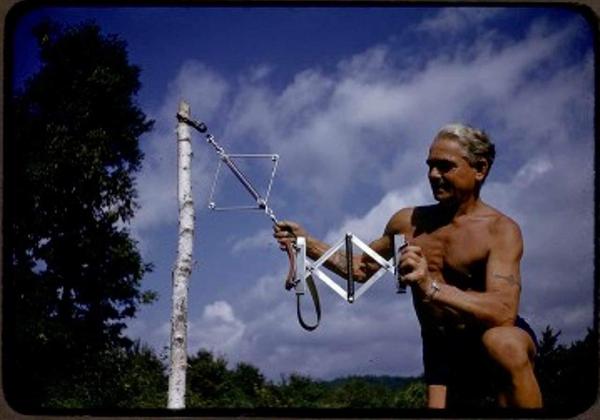
Le Magic Square est sans aucun doute l’un des appareils les moins connus de Joe, bien que d’autres aient également « disparu ». Mon intérêt pour cet appareil a commencé en avril 2022, lorsque mon amie Elaine Ewing a révélé sa découverte d’une série de cinq photos couleur de Joe, jusque-là inconnues de la communauté Pilates. Une des photos de cette collection (prise par le photographe John Lindquist) circulait depuis des années, mais uniquement en noir et blanc. Lindquist était le photographe attitré du Jacob’s Pillow Dance Festival, où il a travaillé pendant 42 étés à photographier de nombreux danseurs et chorégraphes renommés.

Sur la photo en noir et blanc, Joe est entouré de plusieurs de ses petits appareils. Il tient dans une main son Posture and Poise Apparatus (également appelé headpiece). Le neck stretcher est suspendu à une branche. Le magic circle est appuyé contre cette branche, et Joe presse un objet entre ses genoux.

Jusqu’en 2022, j’avais supposé que l’objet en question était le tensomètre — un appareil d’exercice que Joe a breveté en 1938, et que l’on considère souvent comme l’ancêtre du magic circle. Mais la version couleur de la photo de Lindquist a révélé que l’objet n’était en réalité pas le tensomètre, mais bien le Magic Square. On peut également apercevoir le Magic Square en arrière-plan sur une série de photos de la chanteuse d’opéra Roberta Peters prises en 1941 par le photographe Michel Rougier pour Life Magazine, bien qu’il y soit discret.

Joe faisait référence à plusieurs de ses petits appareils comme à des « Magic Squares », y compris les tensomètres pour les doigts et les orteils, ainsi que le neck stretcher, en raison de leur forme carrée. Toutefois, cet article fait spécifiquement référence à l’appareil représenté dans les sources décrites ci-dessus.

Les photos de Lindquist nouvellement découvertes ont permis de mettre en lumière des détails fascinants sur cet appareil mystérieux. Le Magic Square utilise un ressort d’extension, comme le neck stretcher ou le toe gizmo. Toutefois, ce ressort n’est pas étiré en tirant sur les côtés, mais en les pressant, un peu comme pour le hand tensometer, qui avait lui aussi disparu de la scène publique pendant des décennies avant de connaître récemment une résurgence. Le magic circle, en revanche, utilise des bandes d’acier agissant comme des ressorts de compression. Parmi les appareils de Joe, seuls le foot corrector et le magic circle n’utilisent pas de ressorts d’extension.

Lorsque j’ai vu pour la première fois les photos de Lindquist, j’ai pensé qu’il serait simple et « amusant » de recréer le Magic Square. (Je ris maintenant de ma naïveté.) Armée de ma règle, j’ai estimé les dimensions en comparant le carré au neck stretcher et au magic circle visibles sur la photo. J’ai contacté le fabricant espagnol d’équipement Pilates, Arregon Pilates, dirigé par un duo mère/fille dynamique, l’une des premières entreprises à avoir produit du matériel classique en Europe.

Ce n’était pas leur première tentative de ressusciter du matériel Pilates disparu à ma demande. Ils avaient récemment recréé une version du Divana (un appareil combinant tapis, petit tonneau et reformer), ainsi qu’une wunda chair avec des poignées pivotantes inspirées des archives. Je savais qu’ils partageaient ma passion pour la méthode Pilates et son histoire.

Je leur ai envoyé ce que je pensais être des mesures approximatives mais plausibles, bien qu’ils aient étudié les photos pour tirer leurs propres conclusions. Il est vite devenu évident que fabriquer cet appareil n’était pas aussi simple que je l’avais imaginé. Il a fallu plusieurs mois pour produire un premier prototype. Le mécanisme était infiniment plus complexe que prévu, et développer la bonne tension du ressort s’est révélé un défi ardu. Contrairement au neck stretcher ou à d’autres appareils, une mauvaise tension rendait le Magic Square tout simplement inutilisable.

De plus, l’assemblage était compliqué, coûteux et chronophage. Arregon a produit plusieurs prototypes, mais aucun n’était parfait — et nous visons la perfection.

Photo par John Lindquist – Houghton Library, Université Harvard

Aujourd’hui, environ deux ans après la découverte des photos, Arregon a officiellement lancé le Magic Square, et le résultat valait bien l’attente. C’est véritablement une œuvre d’art. Même s’il est impossible de créer une réplique exacte sans modèle original, il est bon de rappeler qu’aucun des appareils utilisés aujourd’hui — même les plus « classiques » — ne sont des copies fidèles des originaux de Joe. Cela inclut les gros appareils comme le reformer, le Cadillac (dont les ressorts sont différents), les chaises, le ped-o-pul, les tonneaux, ainsi que les petits appareils comme le toe gizmo et le neck stretcher. Il existe quelques répliques basées sur des pièces originales, mais au cours des cinquante années qui ont suivi la mort de Joe, la majorité des équipements ont évolué.

Beaucoup des exercices pour les bras et l’intérieur des cuisses que nous effectuons avec le magic circle peuvent être réalisés avec le Magic Square, bien que la sensation offerte par le ressort soit totalement différente de celle des bandes de compression. Maîtriser le ressort du Magic Square demande un contrôle bien plus important que le magic circle. C’est un vrai défi, qui exige du temps et de l’expérimentation. Mais après tout, c’est ce qui fait le charme de la méthode. Joe l’appelait Contrology pour une raison 😉.

Il sera intéressant d’adapter certains exercices de la wunda chair au Magic Square, même si les puristes fronceront peut-être les sourcils 😜.

Pourquoi le Magic Square a-t-il disparu ? Joe l’a-t-il jugé moins utile que le magic circle ? Peut-être, mais rien ne le prouve vraiment. Le magic circle apparaît un peu plus souvent dans les archives, mais la différence n’est pas énorme. À ma connaissance, un seul magic circle original de Joe a survécu, ce qui laisse penser qu’il n’en fabriquait pas beaucoup. Nous savons que Carola en possédait plusieurs, mais on ignore s’ils ont été créés du vivant de Joe.

La popularité du cercle est en grande partie due à Romana, qui a peut-être choisi de le reproduire plutôt que le carré parce qu’il était plus simple et moins coûteux à fabriquer. De même, le ped-o-pul utilisé dans la plupart des studios aujourd’hui n’est pas la version sophistiquée et réglable avec la selle de vélo (qui avait pratiquement disparu avant d’être récemment réintroduite), mais une version plus simple et économique.

Bien que Romana ait adapté le cercle à de nombreux exercices de mat, l’usage que Joe en faisait était beaucoup plus limité. En fait, bon nombre des façons créatives dont nous utilisons le cercle aujourd’hui pourraient s’avérer risquées avec un cercle original en acier et bois.

On ignore quand Joe a inventé le Magic Square, mais les photos de Lindquist datent de 1940, et l’article dans Life Magazine est paru en 1951, soit onze ans plus tard. Cela prouve que le Magic Square n’a pas été abandonné par Joe. Il ne l’utilise pas dans la séance photo, mais il semble soigneusement placé en arrière-plan, ce qui suggère que Joe tenait à le faire apparaître.

Nous ne résoudrons probablement jamais le mystère du Magic Square ; toutefois, grâce au talent et à la ténacité de l’équipe d’Arregon Pilates, sa magie est de retour.

À propos de l’auteure

Rebekah est un être humain extraordinairement doué et multifacette. Tellement accomplie, en fait, qu’énumérer ses réalisations nécessiterait un volume à part — probablement avec un index. Pour l’instant, sachez qu’elle a été élue « Meilleure dans toutes les catégories » en maternelle et qu’elle a héroïquement sauvé plus d’une coccinelle.

Sa gentillesse envers les animaux est légendaire — au point qu’elle a obtenu une exemption à vie de devoir être gentille avec les humains. Le mot qui revient le plus souvent pour la décrire est « envoûtante », bien que « délicieuse » arrive en deuxième position.

Rebekah enseigne le Pilates dans son studio intime (lire : minuscule) en France, où elle parvient à enseigner plus de 200 heures par semaine tout en s’occupant de quatre enfants très demandeurs et d’un chien compliqué. Elle a réussi à entasser une quantité extraordinaire d’équipement dans cet espace réduit. Sa devise : quand on veut, on trouve de la place.

Ses élèves savent qu’il vaut mieux ne pas remettre en question son autorité, ni se moquer de son accent, à moins d’être prêts à faire des teasers supplémentaires… ou à disparaître mystérieusement. Nous avons essayé de contacter certains qui l’avaient fait, mais étrangement, ils sont désormais injoignables.

Ses élèves l’appellent « Grande Sœur », non pas pour son charme irrésistible, mais parce qu’elle voit tout. Elle sait quand vous dormez. Elle sait quand vous êtes éveillé. Elle sait quand vous trichez, alors gare à vous !

Articles en anglais, Pilates

The Renaissance of Joe Pilates’ Magic Square

Very likely you have never heard of Pilates’ Magic Square. The Magic Square is undoubtedly one of Joe’s least known apparatus, although others have also “disappeared”. I first became intrigued with the Magic Square in April 2022 when my friend Elaine Ewing revealed her discovery of a series of five color photos of Joe that were previously unknown to the Pilates community. One of the photos in the collection (by photographer John Lindquist) had been circulating for years but only in black and white. Lindquist was the staff photographer for the Jacob’s Pillow Dance Festival, where he worked for 42 summers photographing numerous renowned dancers and choreographers. The black and white photo shows Joe with several of his small apparatus. He holds up his Posture and Poise Apparatus (also known as the headpiece) with one hand. The neck stretcher hangs from a branch. The magic circle is propped against the branch and Joe squeezes an object between his knees. 

Until 2022, I had assumed that Joe was squeezing the tensometer — a piece of exercise equipment he patented in 1938 that is believed to be the precursor to the magic circle. The color version of the Lindquist photos revealed that the object in question was not in fact the tensometer, but the Magic Square. You can also see the Magic Square in the series of photos of opera singer Roberta Peters taken by photographer Michel Rougier in 1941 for Life magazine, but it is in the background. Joe referred to a number of his small apparatus as “Magic Squares”, including the toe and hand tensometers and the neck stretcher, due to their square shape; however, this article specifically references the apparatus depicted in the sources described above. 


The newly-discovered Lindquist photos brought to light exciting details about the mysterious apparatus. The square uses an extension spring, like the neck stretcher and toe gizmo. The spring, however, is stretched not by pulling on the sides, but by squeezing them, similarly to the hand tensometer, which had also disappeared from public view for many decades but is enjoying a recent revival. The magic circle, in contrast, uses steel bands that act like compression springs. Of Joe’s apparatus, only the foot corrector and the magic circle do not use extension springs.

When I first saw the Lindquist photos, I thought it would be simple and “fun” to recreate the Magic Square. (I must admit that now I chuckle at the naiveté). Breaking out my ruler, I “guesstimated” the dimensions by comparing the square to the neck stretcher and magic circle in the photo. I contacted the Spanish Pilates equipment maker, Arregon Pilates, which is run by a dynamic mother/daughter duo and was one of the first companies to produce classical Pilates equipment in Europe. This was not Arregon’s first foray into reviving extinct archival Pilates equipment at my behest. They had recently produced an interpretation of the Divana (an apparatus combining a mat, small barrel and reformer), as well as a wunda chair with swiveling archival handles. I knew that they were as passionate about the Pilates method and its history as I was. I sent them what I thought were accurate(ish) measurements, although they examined the photos to produce their own conclusions. It soon became clear that making Pilates equipment was not the “simple” endeavor that I imagined. It took months to produce a first prototype. The mechanism was infinitely more intricate than anticipated and developing the proper spring tension was an arduous task. Unlike the neck stretcher or other apparatus, the differences in tension did not merely result in an easier or more difficult workout; the square would not work at all if the tension wasn’t right. Additionally, the assembly was complicated, expensive and time-consuming. Arregon produced several prototypes, but they were not perfect, and we were striving for perfection.


Photo by John Lindquist at Houghton Library, Harvard University

Now, approximately two years after the discovery of the photos, Arregon has launched the Magic Square and the result has proven to be well worth the wait. It is truly a work of art. While it is impossible to create a true replica without an original model, it is important to remember that almost none of the equipment in use today, including the most “classical” pieces, are true replicas of Joe’s originals. That includes the large apparatus such as the reformer, the Cadillac (the springs are different), the chairs, the ped-o-pul and the barrels, and also the small pieces such the toe gizmo and the neck stretcher. There have been some replicas based on original pieces, but in the five decades after Joe’s death, most of the equipment evolved differently than what he originally created. 

Much of the arm work and inner thigh work that we do with the magic circle can be done with the Magic Square, although the spring evokes a wholly different sensation than the compression bands used for the circle. Mastery of the Magic Square spring demands a great deal more control than the magic circle. It is quite challenging and requires some time and experimentation. Of course, that is part of the fun. Joe called his method Contrology for a reason, after all😉. It will be interesting to adapt some of the wunda chair exercises to the square although purists might frown at the idea 😜. 

Why did the Magic Square disappear? Could it be that Joe found it less useful than the magic circle? Possibly, but there is little to substantiate this theory. The circle does appear in the archives more than the square, but not much more. To my knowledge, only one original circle from Joe has survived, suggesting that Joe did not make many circles. We do know that Carola had several, but we do not know if these were created during Joe’s lifetime. The popularity of the circle is largely due to Romana, who may have chosen to reproduce the magic circle and not the square because it was easier and cheaper to make. Similarly, the ped-o-pul that we use in most studios is not the sophisticated, adjustable one with the bike seat (which had all but disappeared before it was re-created several years ago), but the simpler, less expensive version. Although Romana adapted the circle to many of the mat exercises, Joe’s use of it was much more limited. In fact, many of the creative ways in which we use the circle might be risky with an original circle of steel and wood.

Magic Square

Although don’t know when Joe first invented the Magic Square, the Lindquist photos are from 1940, and the Life magazine spread appeared in 1951, eleven years later. This confirms that the Magic Square was not something that Joe discarded. The Square is not demonstrated in the Life photo shoot, but it does appear to be strategically placed in the photos, which suggests that Joe wanted it to be visible. We will probably never resolve the mystery of the Magic Square; however, we are now able to once again partake of its magic. Thanks to the talent and tenacity of the team at Arregon Pilates, the Magic Square has returned to life.

About the author


Rebekah is a supremely gifted and multifaceted human being. So accomplished, in fact, that listing her achievements would require a separate volume — possibly with an index. For now, you should know she was voted “Best All-Around” in preschool and has heroically saved more than one ladybug.

Her kindness to animals is legendary — so much so that she’s earned a lifetime exemption from being nice to humans.  The word most often used to describe her is “enchanting,” though “delightful” is a close second.

Rebekah teaches Pilates in her intimate (read small) home studio in France, where she somehow manages to teach over 200 hours a week, while dealing with four needy kids and a complicated dog.  She has managed to cram an extraordinary amount of equipment into her tiny space.  Motto – where there’s a will, there’s space. Students know better than to question her authority or mock her accent, unless they’re prepared to do extra teasers… or mysteriously disappear. We tried to follow up with a few who had, but strangely, they’re no longer reachable.  Her students call her Big Sister, not because of her charming personality but because she sees everything.  She knows when you are sleeping.  She knows when you’re awake.  She knows when you are cheating so don’t you dare, for goodness sake!

Articles en anglais, Book reviews

Book Review: Carola Trier: The First Woman Ever to Open a Pilates Studio: Portrait of an Extraordinary Journey


Author: Reiner Grootenhuis
Date of Publication: 2020
Available in printed form and electronic format on amazon

There is a species of animal known as the Pilates Nerd (also a line of cute Pilates clothing). This animal lives, breathes and dreams Pilates, chats about Pilates 24/7 with fellow Nerds (Nerds often have tribes), and tries to engage his significant other in Pilates discussions, whether or not significant other is interested (mine is usually not). Pilates Nerds get excited when a new piece of Pilates history is unveiled – a book, a letter, a photo or just any new information. Reiner Grootenhuis belongs to this Nerd species and I am a proud member as well. I greeted the news that Reiner had published a book about Carola Trier, the first woman to ever open a Pilates studio, with giddy excitement that typically characterizes Nerds. While I knew quite a bit about Romana Kryzanowska, the most well-known of Joe’s teachers, and a little about Kathy Grant and Ron Fletcher, Carola Trier was a mystery. I knew that Carola had operated her own studio while Joe was still alive, with his blessing. Both Romana and Kathy Grant had taught at the studio. I also knew that Carola had written a children’s exercise book (I have a copy 😉). But that was pretty much the sum total of my Carola knowledge. I relished the opportunity to learn more about this unique woman, and I was not disappointed. In addition to her contributions to the Pilates world that should not be understated, Carola lived a fascinating life, overcoming overwhelming odds to survive and thrive during a period that was fraught with difficulty.

Before I dive into a description of the book itself, a bit about its author. I knew Reiner from his Pilates Contrology forum, the first and largest Pilates facebook forum, with almost 12,000 members. Reiner teaches and runs a certification program in his studio, Pilates Powers, in Germany, He has authored several Pilates manuals – armchair, Cadillac and reformer (the reformer manuals have not yet been translated into English). Reiner is also a regular contributor to Pilates Intel, a online Pilates magazine, serves on the Board of the International Pilates Heritage Congress and is a Weng Chun Kung Fu teacher.

Back to the book. One of the wonderful things about it is that much of the information within comes directly from Carola herself. In researching the book, Reiner delved into the Carola S. Trier Collection from the Leo Baeck Institute in New York, a huge repository of materials pertaining to the Jewish communities of Central Europe. The collection spans a timeline of five centuries and contains a wealth of information about Carola and her family, prominent Jews of German origin. Within the Carola Trier Collection are correspondence, periodical clippings, photographs (more on those later) and….. Carola’s manuscript, which appears to have been the beginning of her own autobiography. Some of this was handwritten; Reiner painstakingly deciphered the sometimes barely legible handwritten portions. When he was unable to read a word, Reiner included a question mark rather than guessing at the content. I bring this up because it speaks to Reiner’s ability to remain objective about his subject rather than coloring the biography with his own interpretations. When a biographer loses his objectivity and his admiration (or disdain) becomes overly apparent in the pages of his book, readers rightly question the veracity of the information within. Lack of objectivity was an unfortunate flaw of a recent book I read that covered some similar matter.

The material that was written by Carola herself primarily describes her youth, from her intellectual, bourgeois upbringing in Germany to her years struggling as an artist in Paris. This was just before World War II and the climate was already difficult and dangerous for a young female artist in Europe, even more so for a Jewish one. Carola recounts how the pursuit of her dream to become an established dancer led her to the vaudeville theaters in France, where she made a name for herself as a contortionist acrobat on roller skates. She then describes her time in the internment camp in Gurs, in the South of France, where she was imprisoned as an enemy alien and as a Jew, before escaping and later leaving for America where her family had already emigrated.

After Carola’s arrival in the United States, she began performing again until a knee injury led to her to Joseph Pilates. Convinced of the brilliance of his method, Carola opened her own studio with Joe’s blessing and remained close with Joe. She was faithful to Joe’s teachings, although she ran her studio very differently, and her lessons were also structured rather differently. The description of Carola’s life after arriving in America relies heavily on interviews given by Carola’s nephew and her students, such as Jillian Hessel and Deborah Lessen. These testimonies provide an insight into Carola’s determination, fiery temperament and exacting nature. In a biography, testimonies of friends and family and contemporaries are invaluable resources that go a long way toward painting a picture of the subject; third person hearsay should, however, never be substituted as fact, and Reiner is careful to avoid that trap. He provides sources for each piece of information within the book, providing the reader a balanced perspective from which to reach his own conclusions. This is particularly important within the Pilates world, whose history is rife with opinions, conjecture and myth that are readily accepted and perpetuated even when false.

The end of the book is certain to delight Pilates Nerds. It contains photos of Carola executing her mat and reformer routine. The photos are similar to the archival photos of Joe, but with some differences in the order and names of the exercises, including an exercise that I had never seen. Close examination of the photos also reveals some differences in the equipment compared to the ones in the Joe photos and compared to modern equipment (although Carola’s equipment was built by Joe). I won’t spoil the fun for you Nerds out there by revealing anything further. You will have to discover them for yourselves.

The Carola Trier biography does a wonderful job shedding light upon the life of a woman whose journey was equally as compelling as that of her teacher, Joseph Pilates. Her biography is interesting not only because of her contributions to the Pilates world, but also in its own right. It is the tale of a woman who overcame overwhelming odds (her sex, religion, nationality, career choice and imprisonment!) to achieve prosperity and to make her own mark on history. Pilates Nerds worldwide will enjoy this inside look at the life of Carola Trier.

Leggings Reviews

Leggings Review: Liquido Active

You must have noticed that the news is invariably depressing these days.  Even my facebook feed, once filled with baby pictures and articles touting the benefits of kombucha, is now brimming with posts decrying the current political situation.  People are angry; people are sad; there are more shootings and natural (and unnatural) disasters than ever before, and many people I know are suffering from health problems.  I need a short break – something fun and utterly frivolous.   I have, therefore decided to start reviewing leggings.  Why, Rebekah, why, you may ask (if you care, which you probably don’t), waste your years of education that cost you and your poor parents  so many thousands of dollars?  Can’t you contribute something more worthwhile to the world?  Well, I could answer, every day, I work with students who are plagued with chronic back, neck, shoulder and knee pain, and I think most of them would agree that I have helped them substantially.  Or I could just tell the haters to kiss my legging covered ass, but that would be rude and unladylike.  The short answer is that I just think it would be fun to start reviewing leggings.  I’m not going to write about, for example, putting jade eggs in one’s vajay.  I’ll leave that to Gwyneth.  Leggings, however, I know.  I wear them every day.  I own more than I care to admit.  Buying cool leggings is my vice, I confess.  I don’t have any other real vices.  I am practically perfect. 😉 (That is irony, by the way, for those who don’t know me).  I don’t smoke (mostly), nor do I drink (those who knew me in college, feel free to not chime in – there is probably no proof of anything you might want to say anyway –that was before cell phones and social media).   When I have a cool pair of leggings, I instantly feel sportier and stronger, almost like I already worked out, even if I end up not working out.  And leggings are, for the most part, cheaper than cigarettes and booze, or shoes and bags, and definitely cheaper than jewelry.  So here I go.  Enjoy, or go read something else.

The first brand of leggings that I am going to review are by a brand called Liquido Active, a brand based in Australia, although now they have a US base.  I used to order from the Australian site, but I think that now they have a consolidated site that includes Europe.   Shipping to France is not too expensive either and I usually receive my leggings within a week to ten days after placing an order.  I own a lot of Liquido leggings.  A lot.  One of the reasons is because they have such an amazing choice.  Unlike most other companies, they offer about a dozen new limited edition designs every month.  Be sure to order your favorites while they last.

Design

Liquido is known for their beautiful prints.  They do offer some solid colors, but they offer such a dizzying array of beautiful prints, it is a shame to opt for basic black.  I always receive compliments when I am wearing my Liquidos.  Despite their thin material, they are not at all see-through. Kino MacGregor can often be seen in Liquido and has designed a few styles for them, the Om Stars Collection, which are slightly more expensive than the other styles.

Fit

Sizes run from small to large. The fit is fairly true to size, although it does depend on which style you choose.  I am 5’6 (168 cm), and weigh between 57 and 59 kilos (125 to 130 pounds – it depends).  I usually get a medium in the extra long because I favor long leggings.  They also have 7/8 and capri styles.  I have gotten small in the past when they were out of medium and they fit me fine too, except for the compression leggings, which are a bit smaller.  They even have some mini-me styles, so you and your little girl can match.  There are four types of fabric and all of them are exquisitely soft.  They are all breathable, quick drying and offer UVA and UVB protection, with the Freedom fabric being the lightest weight.  They are exceptionally comfortable and do not slip down (I hate to keep pulling my leggings up).  I generally wear my Liquido leggings for Pilates and not for high impact activities such as running, where I prefer more compression.  The UP fabric offers a medium compression, more appropriate for running, but most of the styles are in the other fabrics.

Price

The price is around 58 euros (about 67 dollars).  They have a sales page and often offer up to 40 percent off the sales page during special promotions (Black Friday, Mother’s Day etc.).  They also have a Teachers Appreciation program where they offer a generous discount to yoga and Pilates instructors and other fitness professionals.  Shipping to France costs about 13.5 euros.

Durability

I generally wash my leggings in cool water and hang to dry and have had no issues thus far with my many Liquido leggings.  They retain their vibrant color after several washings.

Where to buy

Liquido Active leggings are available at www.liquidoactive.com.  You can also shop their Instagram page.

*****************************************

I am going to take advantage of this post for a shameless plug that has zero to do with this review- buy the new Pilates emoji T-shirt at http://www.etsy.com/listing/629864481.

Lire la suite « Leggings Review: Liquido Active »

Articles en francais, Pilates

Mais C’est Quoi le Pilates?

Mais c’est quoi le Pilates ?

Quand j’ai commencé à enseigner le Pilates il y a  quinze ans, la vaste majorité des français n’en avait jamais entendu parler. Lorsque je rencontrais les gens pour la première fois et que je leur ai dit que j’étais professeur de Pilates, leur réponse étaient invariablement « Mais c’est quoi le Pilates ? ». La réponse n’est pas facile… Le problème est que le Pilates est difficile à décrire en quelques mots. Quand j’esquissais un début de réponse, leur réaction était quasiment toujours « c’est comme le yoga ? » Alors j’avais deux choix – soit je me lançais dans une description détaillée de ce qu’est réellement le Pilates, soit j’essayais une réponse courte et j’abandonnais avec – « oui, un peu. » J’avoue que parfois j’optais pour la deuxième solution.

Nous voilà en 2018 et maintenant tout le monde ou presque a désormais entendu parler du Pilates. Decathlon a même un rayon de vêtements « Pilates ». Dans tous les grands magasins, je vois des cercles « Pilates », des ballons « Pilates » ou encore des rollers en mousse «Pilates». La vérité est que les ballons et les rollers en mousse ne sont pas des vrais accessoires de Pilates. Le grand ballon est d’origine suisse et les rollers en mousse étaient utilisés par des kinés pour détendre les muscles. Depuis quelques années, ces outils ont été adoptés par certains professeurs de Pilates, mais Joseph Pilates, l’inventeur de la méthode Pilates, ne les a jamais employés. Joseph Pilates ? Eh oui, le Pilates tient son nom de son créateur, un certain Joseph Pilates, allemand d’origine, né à Mönchengladbach en 1883, qui a émigré aux Etats Unis en 1923. Il appelait sa méthode « contrology ».

Si vous êtes en train de lire cet article, c’est que vous avez certainement entendu parler du Pilates. Peut-être que votre médecin, collègue ou voisin vous a conseillé le Pilates. Mais est-ce que vous savez ce qu’est réellement le Pilates? Maintenant que le Pilates commence à être un peu connu, beaucoup d’erreurs sur la méthode et sur son créateur se répandent, surtout dans les magazines grand public mais également parmi les professeurs de Pilates ?!?. Déjà il y a en a qui ne savent pas que Pilates était un homme. Néanmoins s’ils le savent, ils ne connaissent que peu de choses sur cet homme qui a créé la méthode qu’ils enseignent. Certaines de ces erreurs viennent de l’homme lui-même, car Joseph Pilates, tellement convaincu des bienfaits et la supériorité de sa méthode sur les autres méthodes de remise en forme, n’a jamais hésité à embellir son histoire. Une des légendes qui circule est que Joseph a soigné des blessés de guerre pendant son emprisonnement sur l’Île de Man lors de la première guerre mondiale en utilisant les ressorts de matelas pour faire travailler les patients dans leur lit. Et c’est vrai que le « Cadillac », un appareil de Pilates, ressemble un peu à un lit d’hôpital (ou un instrument de torture 😊). Joseph, comme ses compatriotes qui se trouvaient en Angleterre, était bien un prisonnier sur l’Isle de Man, mais des recherches récentes ont démontré qu’il y avait peu de probabilité que Joseph a eu accès à des matelas à ressorts sur l’île, les lits des prisonniers étant construit de paille. Par contre, il a certainement enseigné ce qu’on appelle aujourd’hui les « mat classes » à d’autres prisonniers. Il s’agit des exercices sur le sol, qu’il a décrit en détail dans son livre « Return to Life » publié en 1945.

En quoi consiste le Pilates ? Je vois souvent dans les magazines « fitness » des programmes de renforcement musculaire qui montrent un ou deux exercice(s)soi-disant « Pilates ». Ces exercices n’ont jamais été destinés à être appris en isolation. Le Pilates n’est pas une chorégraphie, mais un système entier, avec plus de 500 exercices. Ce système contient non seulement les exercices au sol (appelés exercices de « mat») mais aussi des exercices qui se font sur des appareils Pilates, tel le Reformer, le Cadillac, le Wunda Chair et la Chaise Haute, des appareils inventés et brevetés par Joseph Pilates. Chaque appareil a ses propres exercices mais il y en a certains, tels le Teaser ou le Swan, qui peuvent se faire sur plusieurs appareils et sur le tapis. Joseph a développé son système qui doit être exécuté dans un certain ordre sur le reformer ou le mat qui suit une logique définie et qui renforcent, assouplissent et équilibrent le corps en entier dans une série qui comprend des flexions vers l’avant, des flexions latérales, des extensions et des rotations. Il y a même des petits appareils pour les pieds, les orteils et la respiration. Quelqu’un qui choisit les exercices au hasard n’a pas bien compris le fonctionnement du système. Par contre, l’ordre et les exercices sont modifiés si nécessaire par des professeurs pour correspondre aux besoins de chaque élève. C’est pour cette raison que le Pilates peut être pratiqué par les personnes de tous âges et conditions physiques. Et c’est également pourquoi il est préférable de prendre un cours de Pilates avec un professeur qui a reçu une formation intégrale avec un apprentissage d’au moins plusieurs mois plutôt que par quelqu’un qui n’a suivi qu’une formation courte ou pire, une formation en ligne.

Est-ce que le Pilates est comme le yoga ? Parfois les magazines montrent des postures de yoga pour illustrer un article sur le Pilates, d’où la confusion ! Ou encore, ils décrivent le Pilates comme un mélange de yoga, danse et Tai-chi. Le Pilates n’est pas une méthode de relaxation et n’a pas de côté spirituel, même s’il contribue certainement au bien-être global – « un esprit sain dans un corps sain ». Certains exercices peuvent ressembler à des postures de yoga mais le Pilates est une série de mouvements et chaque exercice est même censé enchaîner directement au prochain exercice sans s’arrêter, contrairement au yoga qui consiste à des postures souvent statiques (à part le vinyasa yoga). Il n’y a d’ailleurs aucune preuve que Joseph Pilates ait été inspiré de yoga et plus probable qu’il ai été influencé par la culture physique qui a été déjà populaire en Allemagne quand il était enfant. Dans ses deux livres et pendant ses interviews, il n’a fait aucune allusion au yoga, au tai chi ou à danse comme inspiration mais parle plutôt des mouvements des animaux. Mais une chose est certaine, c’est qu’il était convaincu que sa méthode était supérieure aux autres formes de mise en forme.

Le Pilates est-il réservé aux femmes ? Absolument pas ! Joseph Pilates était un homme et avait beaucoup de clients masculins. Il a enseigné sa méthode aux danseurs, aux boxeurs (lui-même était boxeur professionnel brièvement pendant sa jeunesse), aussi bien à des athlètes qu’a tout le monde. Le Pilates est maintenant pratiqué par beaucoup d’athlètes professionnels, tels Ronaldo et Andy Murray, car il améliore leurs performances sportives et leur évitent des blessures qui peuvent être causées par des déséquilibres physiques.

Est-ce que le Pilates est comme le fitness ? Certains cours de Pilates peuvent aujourd’hui ressembler à des cours d’abdo fessiers, surtout que maintenant on enseigne des cours de « gainage » dans toutes les salles de sport. Mais ce n’est pas en faisant des abdos et en disant à l’élève de rentrer son ventre qui fait d’un cours un vrai cours de Pilates. Un cours de Pilates consiste, normalement, en une série d’exercices qui s’exécutent avec une attention à l’alignement et sous l’observation du professeur vigilant qui corrige les mauvais alignements verbalement et tactilement. C’est pour cette raison que les participants à un cours de Pilates ne devraient pas être trop nombreux. Six à huit personnes est l’idéal. Les cours ne se font généralement pas en musique (à part peut-être une musique du fond) pour éviter que les élèves se laissent distraire au détriment de leur concentration.

Et finalement, le cours de Pilates n’est pas une séance de kiné ni un cours post-natal (même si c’est excellent après accouchement dès que le médecin a donné l’autorisation). Quelqu’un qui souffre d’une blessure devrait d’abord consulter son médecin et faire le cas échéant des séances de kiné. Un professeur de Pilates ne ferait pas travailler la partie du corps qui est blessé mais ferait travailler le reste du corps sans aggraver la partie blessée. Quant aux cours post ou pre-nataux – si vous restez allongé(e) sur le sol pendant tout le cours à travailler uniquement la respiration et le perinée, alors vous n’êtes pas dans un cours de Pilates. Le Pilates, c’est de l’exercice. Vous êtes censé(e)  bouger, transpirer, travailler et vous amuser! Pour trouver un cours de Pilates véritable près de chez vous, vous pourrez regarder sur le site de la Fédération des Professionnels de la Méthode Pilates – http://www.fpmp.fr.